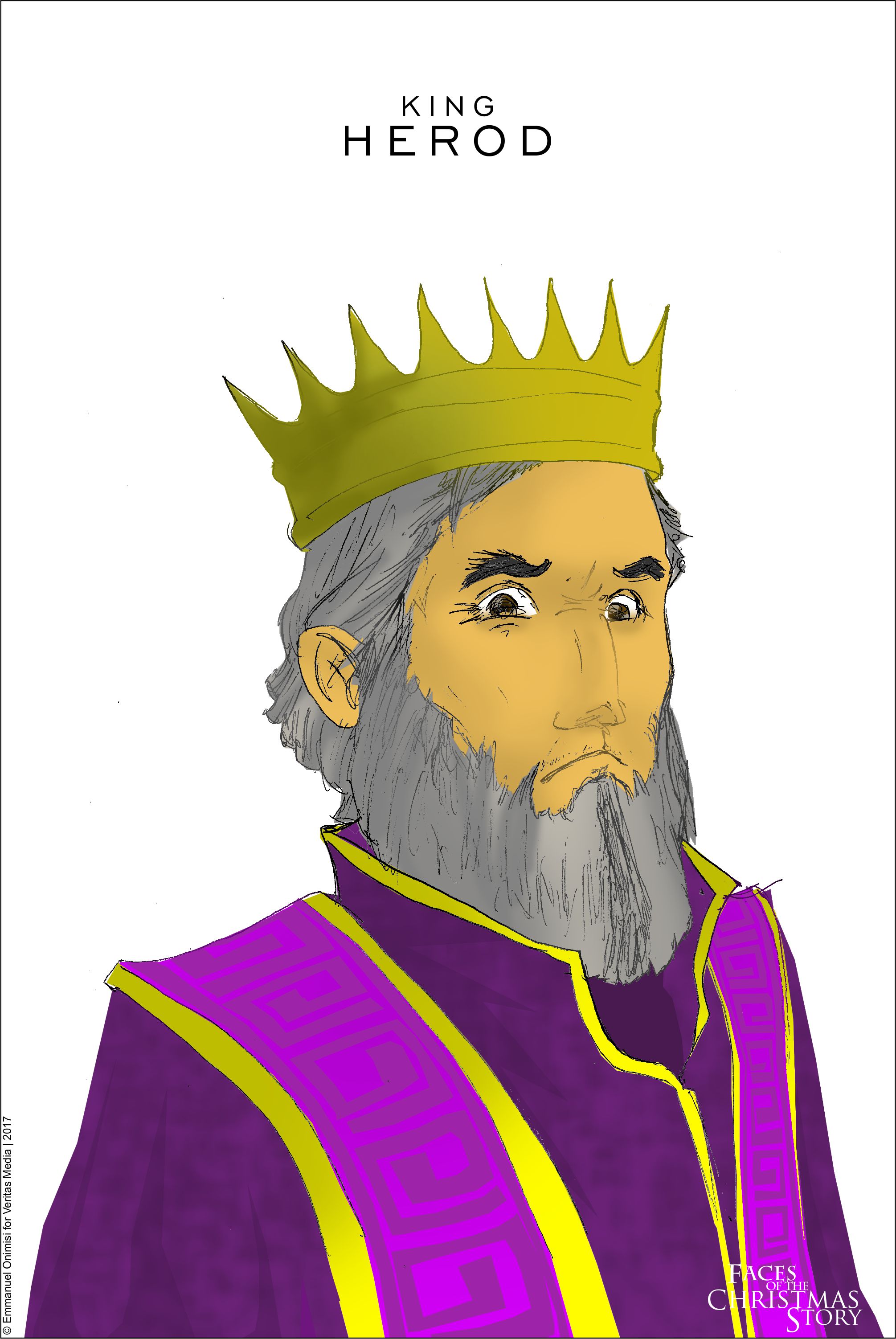
FACES OF THE CHRISTMAS STORY: King Herod

KING HEROD
“When Herod the king heard this, he was disturbed and troubled, and the whole of Jerusalem with him…” Matthew 2:3
Herod the Great was the designated king of Judea in the days when Jesus was born. Judea was already a client state of Rome and Herod was once a governor of one of its territories, the Galilee territory. When a conflict arose he hurried over to Rome to obtain favour with Caesar and, when Rome responded to quench the uprising and end the status quo hitherto, he was placed as ‘king of the Jews’, sent to rule over the entire country. He is largely remembered for his very ambitious and very expensive building projects such as the building of the cities of Caesarea, provision of water supply to Jerusalem, building of about five fortresses, and most especially the expansion of the Jewish Temple on the Temple Mount, a portion of which still stands today as the Western Wall (or Wailing Wall). He sought to make Judea befitting to the standards of the world of his day. He also enriched and gifted other nations, creating a name for himself. These projects brought much employment to the people of Judea.
Son of an Idumean (or Edomite) father and a Nabatean (Arab) mother, his family was circumcised and converted to Judaism. But his decadent lifestyle undermined any religious identification he sought to portray.
The building of the Temple, and his marriage to a Jewess named Mariamne, was all a lobby for the favour of the Jews. But he didn’t stop there. He still lobbied for favour from the pagan population of his land and from Caesar, constructing a Roman Eagle statue over the very gate of the Jewish Temple (an abomination to the Jews), and also building the cities of Caesarea and Sebaste (formerly Samaria) in Caesar’s honour with many pagan idols and shrines. All his building projects were funded by a very severe taxing system that weighed heavy on the people. So while he transformed much of Judea, his motives were anything but selfless, and the people weren’t fooled.
He knew he was ruling a nation that resented him, so he was very paranoid for much of his reign. He had a secret police to monitor and report the general feelings of the populace, a bodyguard of about 2000 soldiers among other units, and he had his opponents forcefully dealt with. He actually had his Jewish wife and her sons for him executed on charges of unfaithfulness and incitement of revolt. So much for Jewish favour there, Herod.
For all his achievements, scholars report that he suffered through depression and paranoia throughout his lifetime. It was in these days that a contingent of Magi, a priestly order of astrologers and royal advisers from the lands of the East, came to visit him. Prepared to host such dignified guests, he was shocked when they declared that they were seeking someone who had been born ‘King of the Jews’, as they had seen his star rising all the way from their lands, and that they had come to ‘worship’ him!
“King of the Jews? I am king of the Jews!” He sent for them and when they had come, he confirmed their quest. It was clear they were seeking someone, and it was definitely not him.
It was all he could do to mask his terror behind a pasty smile. Of course he knew about the expectation in the Jewish conscious of a Messiah that was to come and deliver them from their ‘oppressors’, a term Herod knew many would call him. He mostly dismissed it as the superstitions of a weary people, but the possibility had always stood out in his mind.
Could it be true? Or had these men just come based on the rumors of another possible uprising? News of his turmoil spread to the rest of the city, and everyone else was troubled. They knew that, when Herod fears an uprising, there’s going to be blood in the streets.
Meanwhile, as his people entertained the Magi in an adjoining room, Herod paced. He had to tell them something, or these guys would consider him an uneducated idiot. He had to show these Magi that he was in the know of everything going on in his land. He wanted to find favour in the eyes of these men too. So he sent for the chief priests and learned men in Jerusalem. “So … about this Messiah you all keep talking about…” he began. “Where do the Scriptures say he will be … born, so to say?”
Without missing a beat, they replied him. “In Bethlehem of Judea, your majesty. For so it is written by the prophet Micah, ‘And you Bethlehem…’ ”
But Herod’s mind was already blanking out. He could see the priest’s mouth moving but his pulse thumped in his ears. He rubbed his beard. “Bethlehem, you say?”
His mind was in overdrive. He knew what he must do, but he had to be discrete.
With the priests dismissed he met the Magi privately. “How long ago exactly did you see this star rising?”
“About two years.” They even gave him the exact date, but much of their astrological jargon was gibberish to him.
Could he be late already? He directed them to Bethlehem, telling them to return when they’ve found the child, “…so that I too can come and … worship him.” He felt sick just uttering those words.
That night he stared out into the sky. It looked as normal as any other night sky. He had so much, he had accomplished so much, yet he felt so alone in the universe. No matter how much he tried, he much he acted, he never fully felt appreciated. Now someone else had been chosen to be king of the Jews. A child?! It brought a bitter taste to his mouth. He needed to end this.
But the days passed. And the Magi never returned. Herod was furious. The rejection and flouting of his orders stung. He ordered his soldiers to invade Bethlehem and its surrounding hills, to kill every boy two-years-old and under. Surely that would be his boot to squash this ant before it became a problem (spoiler alert: God sent angels in an undercover mission, i.e. while Joseph was asleep ‘under covers’ ;), to warn him to escape with the child and his mother to Egypt before the soldiers arrived)
But the massacre never brought Herod the satisfaction he craved. He died not much longer, but his last days were wrought with much turmoil and political intrigue. Quarrels with his eastern neighbours brought him into displeasure with Caesar Augustus, a relationship he had laboured to build for years. His health dwindled into a ferocious temper as his insides withered. He felt so much excruciating pain that he even attempted suicide. He is recorded to have said to his sister and her husband, “I shall die in a little time, so great are my pains; which death ought to be cheerfully borne, and to be welcomed by all men; but what principally troubles me is this, that I shall die without being lamented, and without such mourning as men usually expect at a king’s death.”* He ordered that a multitude of distinguished men be invited and, upon his death, they should be killed so that there would, at least, be some mourning in the land. Thankfully, upon his death, his son cancelled that order.
He lived his life seeking the favour of men and died that way. He even tried to kill the One who had come to give him a full and abundant life. He didn’t know.
Herod’s story is a picture of many today. We live in a self-conscious culture where everyone wants to be affirmed and appreciated by others. It is a human desire which, in itself, is not bad, but is also sad. On the social media, for example, it is easy to judge our relevance and fulfilment by the number of likes and retweets on our posts and selfies, to feel hurt or that we did something wrong when we don’t get enough or any, to try to please men so that they can favour us. And this has been translated to how we live our lives. If we could, we would even want to know how many people would mourn us if we died!
It is why many are suicidal today. And it is not a joke.
We all want to be affirmed, because no matter how much we try, there is a void inside that cries for more.
And, as the saying goes, hurt people hurt people. Our desire for affirmation tends to lead to selfish disregard for the well-being of others as we crush them in order to obtain some acceptance. We may not all execute those that hate us, but it has become the base evil of humanity. It was the root of the first murder, when Cain killed Abel because he didn’t get the favour he desired. It is the core of every villain, both in fiction and in reality. At their core, everyone, be they heroes or villains, wants fulfilment. How we go about obtaining that fulfilment tells on our very natures. The hero obtains fulfilment in helping others, while the villain obtains fulfilment in hurting others.
It is why people cheat, slander, betray … assuming that putting others down automatically lifts us up. But all it does is send us all sinking into miry clay (or quicksand). It ruins relationships and marriages too, when each person is seeking their own gain, focused on receiving from the other instead of giving, and judging them based on personal needs.
The void in man is a form of death, and it is a consequence of the sinful nature. There is nothing we can do to fill it, and it always cries out for more. Only Jesus can fill it, and that is what He came to do. God came that we may be whole, complete in Him, fulfilled and full-filled. He came so that we can have Life and live it to the full (John 10:10).
He fills our hearts with His love (Romans 5:5) and lets us know that we are complete in Him (Colossians 2:10), lacking nothing. In Him, we see our true selves: beautiful, loved, accepted, affirmed. We are His own, and He is ours. The more we grow in Him the less we will base our fulfilment on the approval of others. Rather we will realise more and more, and it will be more real in our mindsets, how He fills and surrounds us with His everlasting and boundless love. We have never really been alone, and we never will be.
Immanuel.
Herod did not realise that he had a front row seat on God’s plan to answer the cry of his heart. Don’t miss out on the opportunity God has presented before you too. Call to Him. He is closer than near, and He hears. He wants you to know Him much more than you think. He’s got so much for you.
And, from this place of affirmation in Him, we can more effectively be a blessing to others. This is the kind of life that can give to others without expecting appreciation or reward, and would not be hurt if it doesn’t come. It is the kind of heart that can be slapped (or cheated), and will turn the other cheek. It is the confidence that will put out its best foot forward in love, knowing that it might be stepped on but not minding. It is the life that can break through cold hearts, and warm and comfort them with love.
It is the life Jesus spoke about. It is bizarre and crazy, like walking on water. But it is also supernatural and amazing, just like walking on water.
He showed us what it’s like, dying for us when we were still ungodly, sinners, in enmity with God and without a promise or care of responding to His love. He rose to make the way that we may be united with God in Him, by believing in Him. The way is still open today.
Remember that, this Christmas.
You are loved, and can love.
#7DaystoChristmas
*Source of Herod’s dying quote: Flavius Josephus, Antiquities of the Jews, Chapter 6, note 5 (translated by William Whiston)
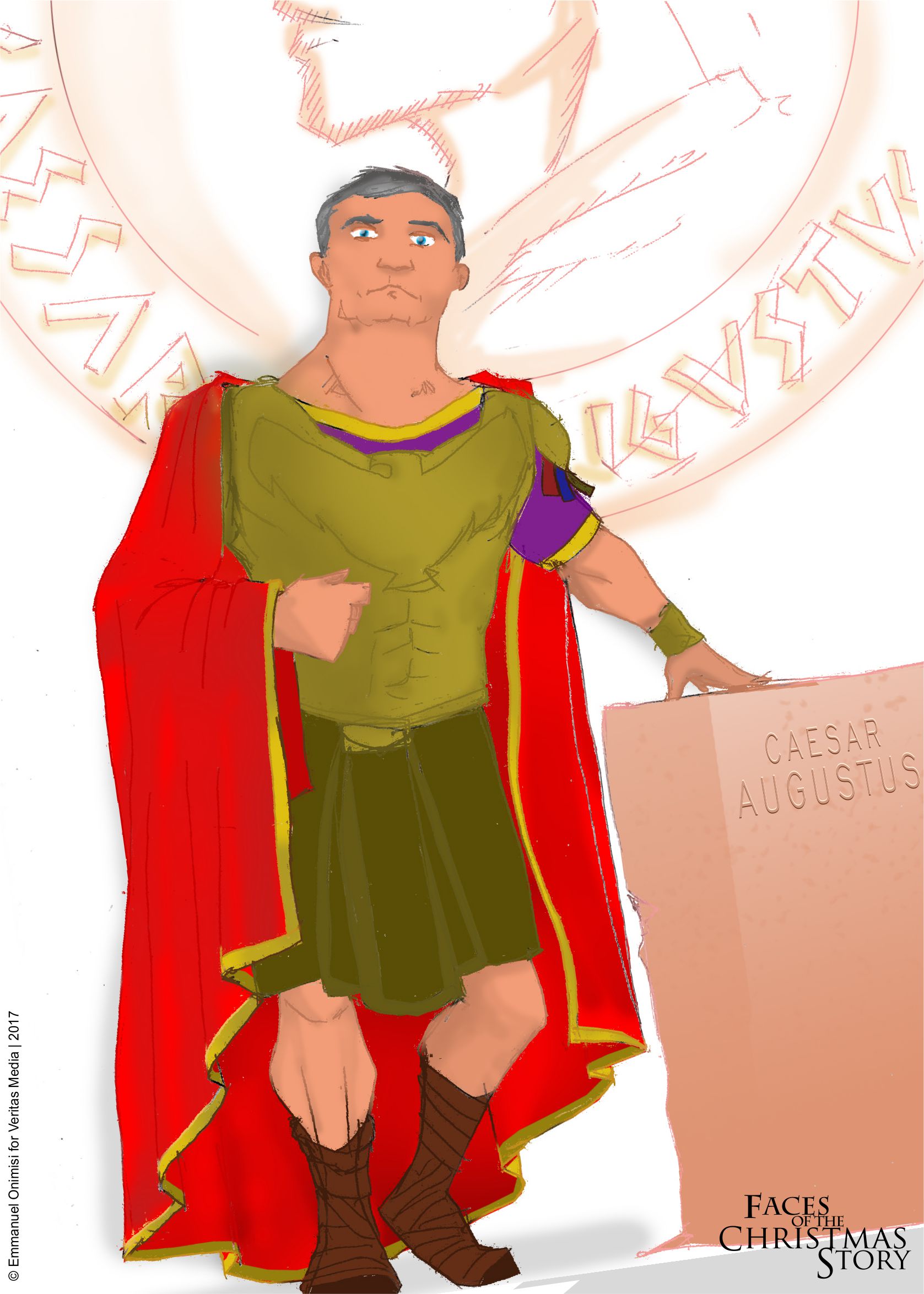
FACES OF THE CHRISTMAS STORY: Caesar Augustus

“And it came to pass in those days, that there went out a decree from Caesar Augustus, that all the world should be taxed.” Luke 2:1


Gaius Octavius was the adopted heir to the Roman throne, being the grandnephew of Julius Caesar. His road to the throne was not so easy, however, as the nation was in the midst of civil wars especially after Caesar’s assassination. Octavius came out victorious, returning to Rome as sole master at the age of 34. Consummate politician that he turned out to be, he settled relations with the Senate of Rome (something his predecessor had totally ruined with dictatorship), rejected any monarchical title like ‘king’, preferring to be called ‘First Citizen of the State’, spread the reaches of Roman rule through conquest of much of the known world, and he turned what was a Republic into an Empire. His reign was an era of relative peace, laying the foundation for the next 1500-or-so years of the Roman Empire. He had left many architectural achievements, initiated a taxing system, an official police, and even a fire-fighting system (yes, this was all BC!) among other things, including a steady constitutional framework. He was a lover of the arts as well, relating with poets and writing some literary works himself. The people loved him. To this day, many historians consider him Rome’s greatest Emperor, considering his many achievements. Some explain, though, that his peace actually came through disguised force and ruthless methods.

The Roman Senate gave him the title ‘Augustus’, meaning ‘the illustrious one’. It was a religious title designating authority over humanity and nature, and was the beginnings of a culture of emperor worship. Full of it, he went ahead to tack on, among many other titles, the title of ‘Son of the deified one’, or ‘son of god’ (the god here being Julius Caesar, who they had already elevated to god-status). Still, he hung the civic crown above his door, a crown that was usually placed over a general’s head as the Latin phrase ‘Memento mori’ was chanted, meaning ‘Remember that you are mortal.’ For all his claims to godly fame, he knew he was a man and would die someday. By 6 BC, as his age told more on him, he was already preparing his stepson, General Tiberius, to take the throne.

With his family name of ‘Caesar’, which he turned into a title for future emperors, Gaius Octavius is now more popularly known as Caesar Augustus.


One of the lands conquered by Caesar Augustus was a middling nation named Judea, which he then annexed to the province of Syria. Moving on to more lands, he had no idea that he had just plugged in to a livewire that predated him and sovereignly superseded any authority he thought he had. He had just been joined to the history of God’s chosen people, and the unfolding of God’s mighty plan.

As it turned out, Caesar sent out a decree for all in the Empire to be registered, like a census scenario, except that they would all have to return to their hometowns. This is what caused a Jewish carpenter and his pregnant wife to make the long journey from Nazareth to the carpenter’s hometown in the South. Bethlehem. It was in that town that their baby was born, a baby who was the true Son of the true God. Jesus the Messiah.


Caesar played a part in the Christmas Story and exited as soon as it was done. Really, his name only occurs in one verse. But God used this pagan ruler in the ordering of set pieces for the fulfilment of prophecy surrounding the birth of Jesus. Micah had prophesied that Messiah would be born in Bethlehem (Micah 5:2), but the key players were based in Nazareth. God used the Roman emperor to fulfil His plans for His own.

In the same way, God can order the political terrain of any nation, or any other official construct, to favour His children. He’s done it many times. Scripture tells us, ‘The king’s heart is in the hand of the Lord, as are the watercourses; He turns it whichever way He wills.’ (Proverbs 21:1, ironically written by Solomon, a king himself)

God used Cyrus, king of the Persian Empire, to allow the exiled Israelites to return to their land and rebuild their temple. He caused Ahasuerus, another Persian king, to favour His servant Mordechai and deliver him from death. He revealed cryptic dreams to Pharaoh in Egypt and Nebuchadnezzar in Babylon, dreams that only His servants Joseph and Daniel respectively, could decrypt in order to elevate them and set them in positions where they could save many and rule with justice. He is still doing that today.

Many nations today are ruled by people who don’t know God. But that is not a barrier to the Lord, as He can cause them to order legislation to favour His own. Beyond governance, even in school or the workplace, the Lord can influence the management to make decisions that favour you. And, in some cases, when His people are thus rightly favoured and rightly placed, He can do even greater things in those offices.

This is what Jesus’ coming promises us. God still rules in the affairs of men. Even of those who have rule over you. The fact that they have become your governor or president or chairman has made them subject to God’s will for you.

That is something to be thankful for, and something we can trust Him for too.


Hold on, there’s more.

Caesar Augustus’ famous last words as he died were, “Have I played the part well? Then applaud as I exit.” He considered the regal authority that he’d put on as emperor, as all play-acting. He knew he wasn’t the big deal they all made him out to be. Memento mori. He died in AD 14, in his 77th year.

You know, your leaders are human too. Even the worst despot has fears and doubts, dreams and aspirations, and loved ones too. They need the Lord just as much as anyone else does. The Bible encourages us to pray for all men, for our kings and leaders and all who are in positions of authority. It is pleasing in God’s sight (1 Timothy 2:1-3). Pray for them to have the right counsel, for their families, and for their souls so that they will know the Lord. As a part of God’s Kingdom, this is your duty. If all is well with your leader, the country will function well as well. As God’s children this is our charge, the watchtowers we are called to defend.

Remember, we are of a kingdom that transcends these, but it’s a kingdom that serves. Pray for your leaders too.

Christmas is a great opportunity for all the world to slow down and relax and rest. With fewer distractions, it is a chance for some to hear and see the true purpose of Christ’s coming: God’s plan for them through salvation in Christ. Pray for your leaders, that they encounter these opportunities and for their hearts to be receptive to listen.

Jesus came for them too.


#8DaystoChristmas

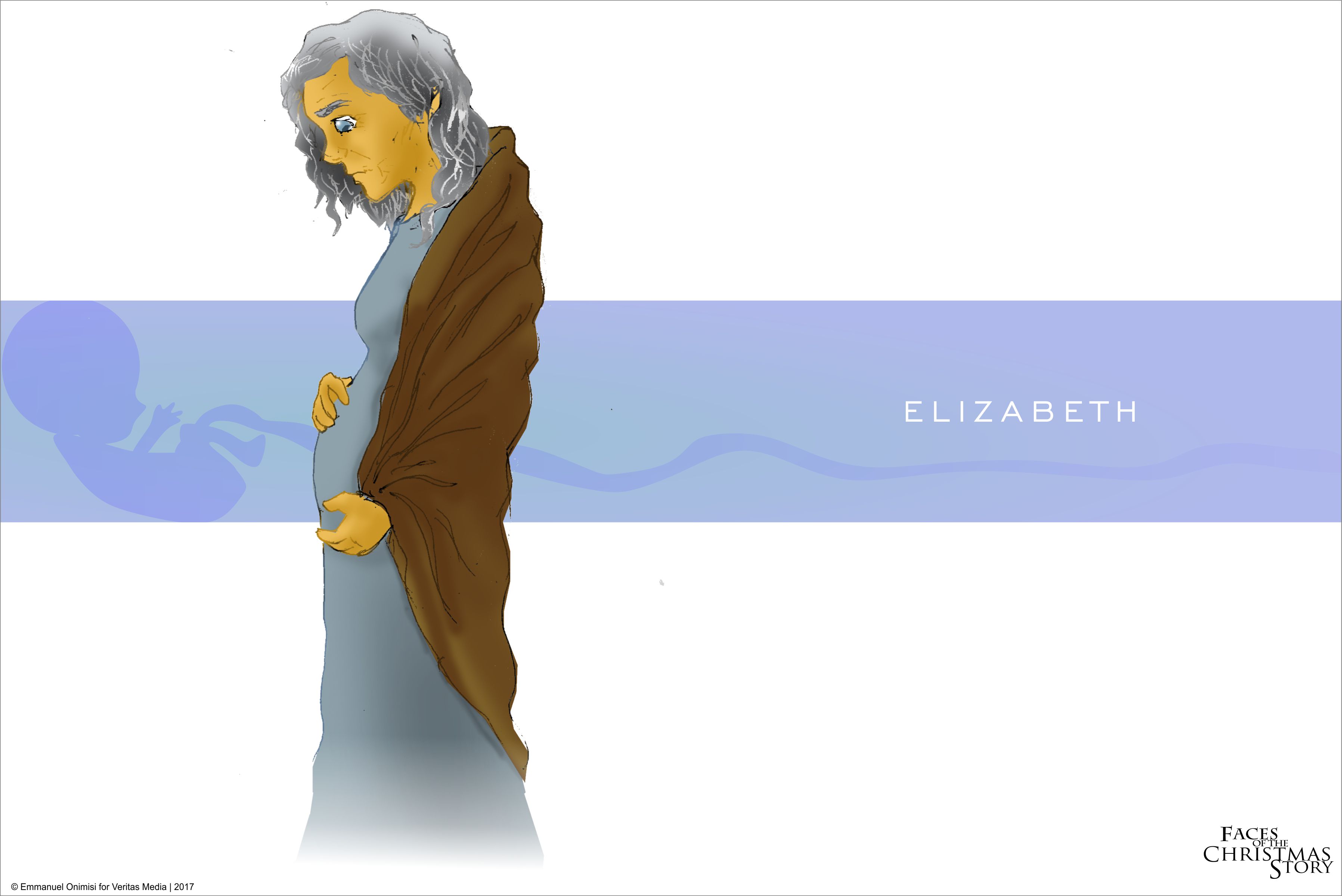
FACES OF THE CHRISTMAS STORY: Elisabeth

#FacesoftheChristmasStory
 
“Thus hath the Lord done unto me in the days wherein he looked upon me, to take away my reproach among men.”
Luke 1:25
 
She had grown up watching women get pregnant and giving birth, fantasizing about when she would do the same. She had probably even helped change the diapers of some relatives’ babies on occasion. She got married and couldn’t wait to have a baby. But she didn’t. As the months passed, the questions started coming. Aunts were all too willing to give their unsolicited advice on ‘successful baby-making’. At first it was amusing, until it became frustrating. The months turned to years. Her friends’ babies grew into adults, got married, and were having their own babies already.
The questions dwindled, soon replaced by whispers. Soon those whispers were replaced by silent furtive glances. Everywhere she went, she could feel them. Sure, the people respected her, but it was the things they didn’t say, the things she knew they were thinking, that stung the most. She was the barren old woman from down the street. Barren. A name she had never thought would be hers.
God knows how many times she prayed. Were they being punished for their sins? Her husband was a priest, and she was a direct descendant of Aaron, the first high priest. That alone should have given them points before the Lord, but still no babies came.
Was God hearing her? Was He even there? Questions she didn’t dare put to speech. After years of agony and sadness, she settled for what they had. After all, His ways and thoughts were higher than theirs. They served God faithfully still.
One day her husband returned abruptly from the Temple without sending prior word. Literally too, because he had no words, since he had been stricken dumb. Hours of panicking and frantic sign gestures later (and the mental note to learn sign language ASAP) she was finally able to get him to write down what had happened. Long story short, the Lord had sent an angel to tell them that they would have a baby. A son. (Why couldn’t he speak? You can read about it in yesterday’s post, or better yet, check out the real account in Luke 1:5-22)
It was hard to believe. It took her a while to accept it all, but in the days that followed, she knew. She could feel it … HIM … she could feel him forming in her. “Oh dear God! So this is what it feels like? I really am having a baby?”
It’s not that she had forgotten she had a womb, it’s just that she had not needed it or even had a reminder of its presence in over a decade! But this was new. This was…different.
What would she do? How would she live, taking care of her silent husband and nursing a pregnancy? How could she, a post-post-menopausal woman, move around town with the prominent bump leading the way, an embarrassing reminder that she was carrying something that was not for people her age? She felt ashamed. The rumours would only reach a fever pitch. She couldn’t dare go out again.
But in her heart, she was hit by the reality that God had blown the barriers she had settled for and invaded her space. Prayers she had long stopped praying were being fulfilled, right in her own body. Not her neighbour’s body this time, not a woman from the stories of the days of the patriarchs … but her. “Me…?” And it gladdened her heart. “So this is the extravagant way God wants to take away my shame?”
For Zacharias it was a son, but for her it was personal. She carried the pregnancy. God had done something in her body. Her own body.
It was a miracle. For a long time, miracles were just the stuff from the Scriptures. Like the Lord parting the Red Sea, or stopping time for Joshua’s armies to prevail, or making Aaron’s dead rod bloom. They were the stories she loved hearing as a young girl. But now, a miracle had been wrought in her own life – in her own body. The Lord had chosen her.
 
Elisabeth’s story is a picture of what Israel was going through. Their history was full of accounts of God’s miraculous intervention time and again. But for the past 400 years or more, precious little had occurred beyond the ordinary. Reality overshadowed them as foreign nation after foreign nation invaded and took over their land. Even the prophets seemed an order of the past, so there was little if any hint of divine intervention. Where was the arm of the Lord? For many, even if they did not admit it, the miracles were a thing of the past. Those historical accounts were little more than myths to some. God and His ways were probably just a coping mechanism, just in case. Still, Israel felt abandoned.
But God had not forgotten them. He was coming to them, and He was coming in a BIG way, in a way that would be so grand it would be embarrassing.
Like a soldier returning from war to meet his fiancé after years of separation, who lavishes her with lots of gifts, lots of money, a new car, teaches her to drive, and spends quality time with her … all on his first day back. Her friends are watching, bewildered as they whisper among themselves about all the attention she’s getting. And just when his fiancé has gotten embarrassed enough, a troupe of mariachis that he’s paid comes out of hiding to serenade her (she loves Mexican music … Why is it always Mexican music?). Her family has been in on the surprise, and they join the circle of onlookers with knowing grins as her Romeo drops to his knee, pulls out a ring and asks her the question…
“Will you … go see The Last Jedi with me?”
I’m just kidding. He asks her to marry him, while everyone stands in awe, literally going, “Aw…” The lady wipes a tear. (Hey, was the ring an onion ring?) You get the picture. He is with the love of his life, and it doesn’t matter what anyone thinks. He will ‘spoil’ her with enough to make up for the lost years, and enough to set up their new life together. Enough to show her his boundless love for her and his delight in her.
This was God’s promise to Israel. He’d said, through His prophets, that He would not only save them from their enemies, but would also lavish them with His goodness, would give them a great kingdom with a great king, so that all the world would see His faithfulness. And He came to save, not only Israel but all the world, totally overshooting the ‘save-them-from-their-enemies’ bit, giving a new life and an inheritance to all who receive His salvation, making them part of His endless kingdom, where He is King. He is awesome like that, always doing exceeding abundantly above all we could ask or think. He saves to the uttermost.
That’s the big picture, and I’ve not even come close to describing it.
But Elisabeth’s story shows us something even extra special. “God has come, for ME.” The blessing of God, in the form of her son, was a flashing neon sign to everyone around that God had done something supercalifragilisticexpialidociously AWESOME in the life a woman well past her prime. Everyone knew her as Barren. Now she was Fruitful. God had visited her life and left His fingerprint for all to see.
It’s the gift of God being with us, among us, in us, coming into our very situation and changing it with the peace and blessing of His very presence. Immanuel. God in the life of a person changes everything, setting things right.
It’s what He did in salvation. It is a blessing upon many, and a blessing upon each one that receives Him. A blessing upon you. That men will see His awesomeness in you as well.
It’s what He can do in your life. If you’re His child you are so much more set up for His hand to work wonders in your life.
And He does. Though our lives may seem to define ordinary, He has set things in motion on your behalf.
Sometimes we don’t think we see His miracles because they don’t all seem spectacular. How wrong we are. I think it was Max Lucado that wrote, “A coincidence is a miracle where God chooses to stay anonymous.” You walk into a building and the first person you meet gives you the information you need to avoid unnecessary stress. You feel a prompting to take a certain route on your way home from a stressful workday, and on that route you meet an old friend whose presence lifts your spirits. Sometimes miracles are like that.
Some miracles are a little more direct. Let’s go back to Elisabeth for a moment.
Remember she’s expecting a baby and supporting her mute husband. She’s going to need a lot of help. So what does God do? He’s set up Mary, her younger cousin, to come down all the way from the other end of the country to visit her (Luke 1:36-40). Mary stayed there until the Elizabeth’s baby was born. Many times, just like this, God uses people to help us. He may use someone to call you with words of encouragement at a moment when you’re feeling down. Someone else may be ready to mess up your day with an annoying Whatsapp chain message, but that person is suddenly distracted by joy at the news of his daughter finally gaining admission to the university of her choice. Wheels within wheels, God is working miracles just beyond our sight.
He may even use you in the working of a miracle in someone else’s life. He did that with Elisabeth. Mary had just been told that she too would have a baby that would be the Son of God. The young lady was still going over the ramifications of this when she entered Elisabeth’s house. Suddenly, the baby in Elisabeth’s belly leaped and she, suddenly spoke words that confirmed what Mary had heard from the angel, further establishing her confidence in God’s promises. God used them both to encourage and build each other’s faith. That’s His desire, to use us to bless one another. But first, like He placed the babies in the women’s wombs, He must give you His kind of heart. That is the kind of person He can use to do His will and be blessing. That’s what Jesus’ coming was all about, to make you that kind of person.
And, yes, God does overt miracles too, through the hands of His children. You can be used of God to heal the sick, cast out devils, and even raise the dead. These are the qualities He’s promised to all who believe in Him and His work of salvation (Mark 16:15-18). If you are Christ’s, this is your nature and ability. It’s all His gift to you.
 
There is so much more we can learn from Elisabeth’s story, but I’ve kept you here long enough. It was not an accident that the writer of the Biblical account told her story together with her husband’s, Zacharias (spoiler alert: he gains his speech back in the end). While Elisabeth’s story shows us that God can do great miracles, even the impossible, in our lives, Zacharias’ story teaches us about faith in God, even in what looks impossible. Needs are a very common part of the human experience, both those that can be met and those that are a bit harder to meet. In all things, let your faith be in God, and you will see His hand at work in your life.
Don’t let your heart get weary. Miracles are not alien to God’s children.
After all, they are our Father’s specialty.
Remember that, this Christmas.
 
May you grow stronger in faith, established in the knowledge of His faithfulness in Jesus’ Name.
Amen.
 
 
“…blessed is she who believed that there would be a fulfilment of the things that were spoken to her from the Lord.”
Elizabeth speaking to her young cousin, Mary, in Luke 1:45
 
#9DaystoChristmas

FACES OF THE CHRISTMAS STORY: Zacharias

#FacesoftheChristmasStory

‘But the angel said unto him, “Fear not, Zacharias: for thy prayer is heard; and thy wife Elizabeth shall bear thee a son, and thou shalt call his name John.” Luke 1:12

Imagine you are sitting on a park bench, scrolling through your phone while waiting for the 3 o’clock bus. On a hunch, you look up from your screen to see a stranger sitting beside you, smiling.
“Hello…” you say, but what you’re really saying is, “Do I know you?”
The stranger proceeds as if you two had been in the middle of a conversation. “What if I told you that by this time tomorrow, you will be able to fly?” He stares straight into your eyes unblinking. He actually believes what he’s just said, and he expects you to believe it too. You, fly?
What would you do? What would you say?
I would probably reply, “Sorry, but I don’t do drugs,” before I make up an excuse to leave. I would always look back on that moment as a weird one, but I would wonder about the possibilities, somewhere in my subconscious. I would remember the times when, as a kid, I tied a wrapper around my neck like Superman and leapt up, up and away … unto the floor. Living with a little concept called Reality, and it’s distant cousin ‘Gravity’, has taught me that I can’t fly, so I don’t even try or even entertain the possibility. And with that, I shove the memory of the stranger’s pitch into the ‘Don’t-even-think-about-it’ cabinet of my mind.
That’s probably what Zacharias felt like when he, while performing his priestly duties in the temple, was told by the angel Gabriel that he would have a son. He and his wife were ‘far advanced in years’ (read, they were really, really old) but they had no children, and it was definitely not for lack of trying. They had prayed and trusted in God for at least a child, but none had come. Yet they remained faithful to Him. Zach had probably even resigned to serve God wholeheartedly, even if God didn’t give him a child. And that’s quite commendable too.
But now, an angel appears and tells him he would have a child? A son, no less? Of course he was amazed that an angel had appeared to him, and this was clearly from God … but what was this? Could he dare get his hopes up again after watching them get dashed for decades? Could he dare try to even wrap his mind around all the angel said about this ‘son’? Was this a practical joke from on high? Did God even do practical jokes?
His doubts stood abreast to the angel’s words, and all Zach could say was, “What proof can you give me, so I can be sure? I’m really really old, and my wife is an old woman too.” And, if you know the story, Gabriel said that because he doubted, he wouldn’t be able to speak until those words were fulfilled. And, just like that, Zacharias couldn’t speak.
Every time I look at this story, it looks a bit unfair. [Am I permitted to think that?] So Zacharias doubted, but haven’t we all? He was only human. Why did God expect him to believe the unbelievable? I even tried explaining it away as Gabriel acting rashly without God’s permission, but angels don’t operate that way. They call Him the Lord of hosts for a reason. There’s a chain of command for heaven’s armies, and God is at the top, and none move without His permission. Those angels that rebelled and left their assigned posts were cast out and bound (Jude 1:6). If Gabriel had broken rank here he’d have been out of a job too and, well, we still see him visiting Mary a few verses down, so…
So why treat an old man so?
In the days and weeks that followed, Zacharias might have had a conflicted mind; the guilt of doubting God’s words battling with the question of why God would do this. And just in case he wondered if it was all in his head, his tied tongue was proof enough that it was still so real. And Elizabeth’s cheeky remarks about the cat finally getting his tongue didn’t help matters. But what was this about her feeling dizzy these days? And was she gaining weight or, was her belly getting bigger, or…?
And then it dawned on him that it was real. They really were having a baby! How did this happen? Of course he knew how it happened, he just didn’t expect it to result in a baby. In their old age? Impossible! But then, God had said they would, hadn’t He?
The reality of his doubts stared at him every day, along with evidence of God’s ability. If he had just believed perhaps he would still have his speech. Oh, to have the faith of their forefather, Abraham. So, apparently, God expected them to have that kind of faith. But now, Zach had doubted and he was stuck without speech. Maybe this would be with him forever, like Jacob’s limp. Or, like the angel said, perhaps when the son is born it will all be over…
In the months leading to delivery, Zach’s understanding of God’s ability was proven to him. The evidence before him was too much to deny. The angel’s words played in his mind over and over. And he knew that it would be true. Not only were they having a son, but this boy would be a major part in God’s plan to prepare His people for Messiah? Despite his doubts?
In time, the baby was born and Zacharias named him John, just as the angel had said. It was quite providential, since John means “the Lord is gracious,” or “The Lord has stooped down to favour us.”
And then, Zacharias’ speech was returned. And what did he do? Now that his words could match the faith built up on the inside, filled with the Spirit of God, he spoke words of blessing and prophecy, telling of what God was set to do through Messiah and through John, his boy. (John shows up in later chapters as John the Baptist)

Doubt is a part of our human experience. It is a consequence of our fallen nature. Since we are used to the mundane reality around us, accepting God’s promises that seem to be above the normal is not easy, and doubt sets in. That’s human. But to relate with God, we must have faith; faith in Him and His ability. And God wants to be a part of our lives much more than we want Him to, but our doubts prevent us from allowing Him.
So what does God do? He doesn’t need to take our speech. He has a better solution: he gives us new hearts that can grasp and believe His words, and then we can say the right things. He did this through the sacrifice of his Son, Jesus, creating new hearts in all that believe in Him. Zacharias was living in a time before this Redemption plan had reached fruition, but God still wanted to use him. So, however long it took, some faith was built in him. And, ironically, when he could speak, it was this Redemption Plan he spoke about (see Luke 1:69-75).
Now, faith is a gift to anyone that trusts in Jesus. It is through this faith that we are saved, all an act of the grace of God (Ephesians 2:8). And with faith, He can do so much in and through us. Our part is to keep or minds focused on God’s ability, even when facing insurmountable odds. In reading His word and following Him, we grow stronger in faith. We would trust in His words better, we would speak as He pleases, and He will do great and mighty things in and through us.
We may still encounter doubts at different points in life. The giants and mountains we will face may be bigger than the ones we’ve encountered before. But the more we follow Jesus, the stronger we are in faith, and the better we can overcome doubts when they come up. So when the giants come, we send them to the ground, and when we meet the mountains, we send them for a swim.

Zacharias, and Elizabeth’s story by extension, may seem like filler episodes in a season-long Christmas TV show, not furthering the plot or telling us about the main characters. But they are anything but fillers because they show us the human faces of the time. Zacharias shows us that, true enough, while we were unable to meet up to God’s standards, despite our doubts and lack of faith, despite the lethargy that had set in with reality and it’s unfulfilled promises … God was coming to our neighbourhood and bringing us to His. He didn’t wait for us to measure up to His standards before calling us. Now all we have to do is to respond to his call, by believing in Him. He’ll handle the rest, because He can.

Elizabeth’s story … well, she’ll take the spotlight tomorrow. See you then.

“Blessed be the Lord God of Israel; for He hath visited and redeemed His people, and hath raised up an horn of salvation for us in the house of His servant David; as He spake by the mouth of His holy prophets…
…that He would grant us, that we being delivered out of the hand of our enemies might serve Him without fear,
In holiness and righteousness before Him, all the days of our life…”
Zacharias speaking in Luke 1:68-70, 74-75

#10DaystoChristmas

FACES OF THE CHRISTMAS STORY: The Angels

‘And without controversy great is the mystery of godliness: God was manifest in the flesh, justified in the Spirit, seen of angels…’ 1 Timothy 3:16

While the Bible tells us a lot about the activities of angels through the history of God’s people, they do not take centre stage and, as such, one can’t really trace the time of their origin. Some things we know, however, are that they are spirits, they were created by God, they worship Him, they are His messengers, they serve the heirs of salvation, and they do not die.
Also, they are so strong that one killed an army of 185 000 men in one night. And Jesus made reference to the fact that there are whole legions of them (over 80 000), so … yeah, they are quite a lot, and quite powerful too.
So picture this.
Did you know that the angels rejoiced at Creation (Job 38:7)? They had never seen a material world before, nor ever experienced such a dimension as Time, yet they watched as the Lord made these novel constructs, and they rejoiced. “How awesome is our Lord! He is in a class of His own … Holy!” Just when they thought God was so awesome He went ahead and blew their minds, making water and plants and animals and … to top it all, He wanted to make a being in His image and likeness out of, ahem, clay?! Of all the gems in the universe, He chose red earth? Oh well, He knew what He was doing. And what He made was a Clay-being, living and breathing. So much potential locked inside ‘walking Clay’. “Isn’t the Lord awesome?”
And God loved Clay. He gave authority in the material universe to Clay, and the ability to make things, to reproduce after his kind. They spent much time together, like friends. It was a privilege to watch, even much more to experience. But the angels could only watch in amazement as Clay experienced it all.
But Clay went ahead and ruined everything. He sinned and introduced an evil into God’s Creation, an evil that made Time a dreadful thing because of the end it promised. An evil called Death. And it was all because of Clay.
But the Lord didn’t turn away, loving as He is. He stuck with Clay and gave him rules and instructions to keep Death away a little longer, and to allow Clay and his descendants to still be able to interact with the Lord, in spite of their fallen, flawed and Death-tending nature. Over the centuries the Lord would even have to send the angels to help Clay’s people out of their self-induced mishaps and the consequences of their actions. Sometimes He sent them to help those that actually pleased Him. But in the end, Death still took over their bodies and they were separated from the Lord for the rest of eternity. For beings that lived all their lives in an immaterial realm, the ramifications of such a separation were stark and horrific to even consider.
Yet Claykind — or ‘mankind’, as they like to call themselves — lived their lives with its pursuits and desires, ambitions and dreams, oblivious to the larger supernatural world that surrounded and influenced their courses, oblivious to the battles the angels fought on their behalf in the unseen in obedience to the Lord’s orders, and oblivious to their impending eternal doom. Anytime they looked at mankind it was his cringe-worthy fallen state that stared back at them.
But then, the Lord had never strayed from His plan.
In the fullness of time, it all unfolded. The sacrifices and coded notes He’d slipped to mankind over the centuries through the prophets suddenly made more sense. He was going to settle the Man problem, by becoming a Man Himself.
Ah, the privilege! Such a wonder! Such a marvel! For the Creator of Worlds to take on the frame of the very creatures that had rebelled against Him. It was unspoken of in any other terms, but then it was the Lord here. He was coming in to make things right.
He had come, and He was a human baby.
“So this is what the Lord looks like? A Baby?! That’s Him right there, and the people are oblivious to even this? Have they no idea what’s just happened? Have they not an inkling of how privileged they are?”
Soon the order rang out, and one of the angels zapped over to a group of human shepherds to tell them the great news. Soon as he flicked the visibility cloak on, the men gasped in fear at the alien intruder. “Whoa, don’t be afraid! You won’t ever have to be afraid again, because what I’m here to tell you is GREAT NEWS about something that will bring joy to all your kind, EVERYONE! Because, for you, this very day, a Saviour has been born down in David’s town! He is Messiah, yes, the One you’ve been waiting for. He is the LORD! But instead of a shiny being, what you’ll find is a Baby wrapped in cloths and lying in a manger—” [a paraphrase of the account in Luke 2:10-12]
The men were still trying to grasp it all when the angel was suddenly joined by a heavenly knighthood, a multitude of them, singing and rejoicing! The skies were agog with light and music and joy so thick. The gist of what they sang was summarised as, “Glory to God in the highest! And on earth peace, goodwill toward men!”
They understood that God was bridging the gap between Himself and man, by Himself. But this would not be the end. They would watch Him grow as a man. They would watch Him die, and wonder why. They would watch Him rise, making the way for mankind to become a newer kind of being: sons of God. The Godkind. A people that are pleasing in His sight, and would do His will always. The product of God in union with man.
The journey to this was long and wrought with much agony, but it was the Lord’s doing. And He did it well. And the angels watched it all.
And they still watch, amazed by His goodness and faithfulness shown toward us. They are not to be worshipped, and they are quick to deflect any attempt to worship them, quick to point the attention to the One that deserves it all.
It was all His doing.
And when they look on the New Creation, the result of His sacrifice and victory, they are amazed over and over again.

“How favoured is mankind? The Lord has brought peace and goodwill to him.
How awesome is our Lord?
Just when we think He is awesome, He keeps on blowing our minds!
The Lord God Almighty is in a class of His own!
He is Holy!”

‘All [the prophets] were told was that they were serving you, you who by orders from heaven have now heard for yourselves – through the Holy Spirit – the Message of those prophecies fulfilled. Do you realize how fortunate you are? Angels would have given anything to be in on this!’
1 Peter 1:12

#11DaystoChristmas

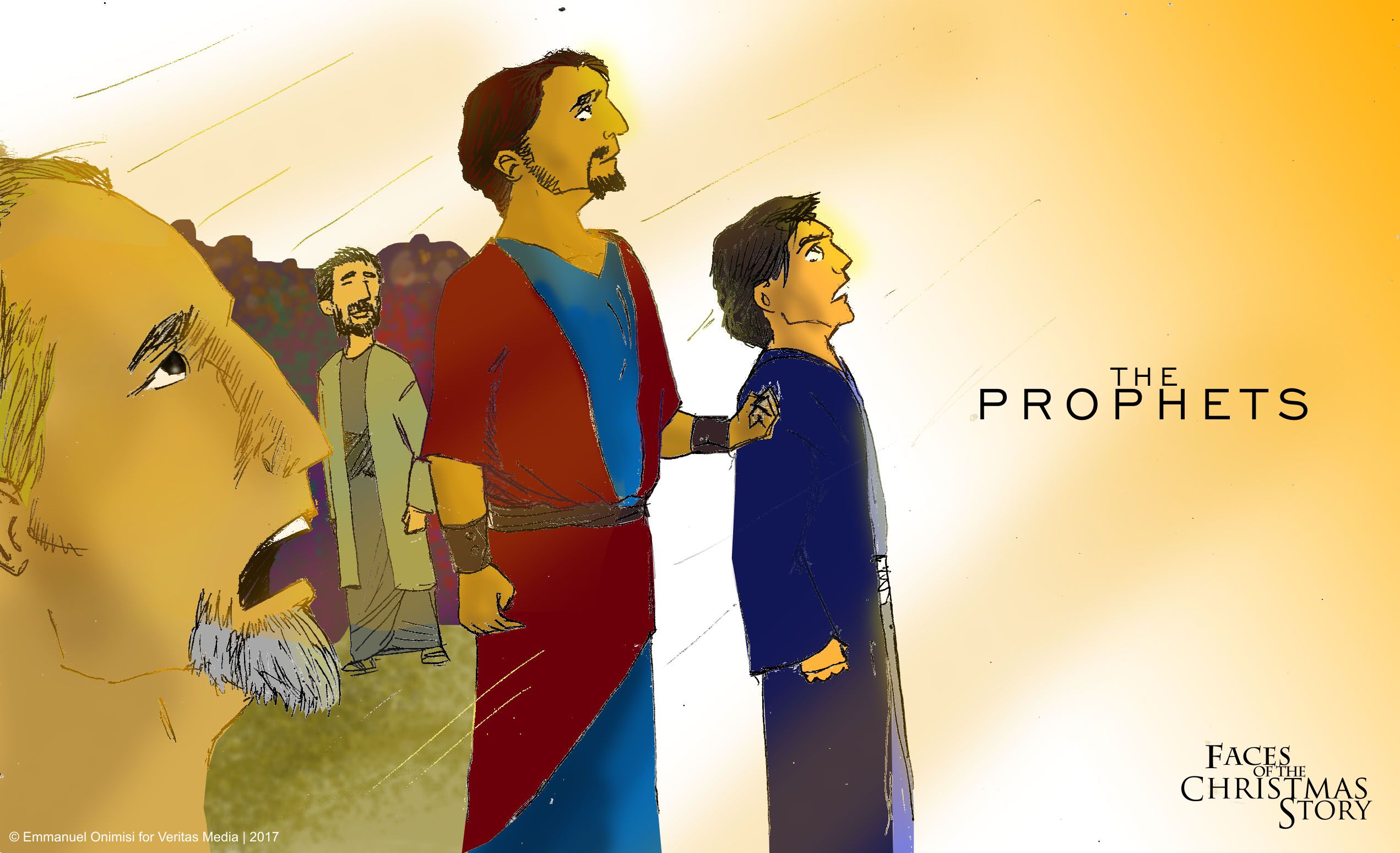
Faces of the Christmas Story: THE PROPHETS

‘Going through a long line of prophets, God has been addressing our ancestors in different ways for centuries.’ Hebrews 1:1

When we think of the prophets, much of the time we imagine old men with flowing beards bellowing words of doom with glazed eyes, ready to rip their clothes at the slightest hint of blasphemy from their audience. Well, some of them were like that. But some of them were kings like David and government officials like Daniel.
Whenever God wanted to let His people in on what He was doing, He spoke to His prophets who would then speak to the people. So, no, these prophets were not ‘fortune-tellers’.
The people of Israel lived through some of the worst times. From slavery to finding a homeland, to raising a kingdom, to occupation by invading armies, to a scattering and an exile and the plundering of their land, to their return to that land, to another invading army coming in … phew! Talk about a rags-to-riches-to-even-more-rags story! But in all this time, God did not leave them alone to face it. He had His prophets among them, men who would speak to them exactly what God needed them to hear. Sometimes theirs were words of judgment, sometimes they were words of comfort. But one thing the people of Israel knew was that God had not abandoned them. These prophets were given to God, faithful to Him so that they could be effective mouthpieces for Him to inspire His people.
In the midst of their prophecies and teachings, the prophets were inspired of God to utter and write about His Big Plan: God was going to save them! God was going to raise someone who would bring them to a prosperous place, a King that would bring them home and restore their glory. While these prophets had glimpses into these plans, they did not fully understand it, but they wrote the prophecies as they were inspired by God. Some had their contextual interpretations, but they did not fully know.
They told of how he would be born from the tribe of Judah (Genesis 49:8), from the family of Jesse (Isaiah 11:1) and a descendant of King David. They told of a ‘son’ that would be born to rule them in a peaceful and never-ending kingdom, who would also be the ‘Mighty God’ (Isaiah 9:6-7). They told of how He would be born in Bethlehem (Micah 5:2).
What they didn’t realise was that they also spoke of the same Person when they prophesied about an anointed one that would be killed for the sake of others (Daniel 9:26), a suffering servant that would be scourged to bring healing to others, be rejected and despised, stricken for the sins of the people (Isaiah 53). They probably thought they were describing their own pain and agony when they wrote about someone that would be forsaken by God, be pierced (long before crucifixion was even invented), and whose clothes would be gambled over (Psalm 22). They probably didn’t even link it all together when they wrote about someone who God would not leave in the land of the dead, but would raise to life (Psalm 16:10). They didn’t know this was all God was talking about when He talked of giving them new hearts so they can always do what is pleasing in His sight (Ezekiel 36:26-27)
Only later, by the inspiration of God’s Spirit, would the apostles look back and see the road map God had prepared long before, telling of what He was doing. They could look on this, gain more understanding, and edify one another, confident in God’s faithfulness to His Word. (1 Peter 1:10-11)
The Prophets lives were not wasted, however, because in the time before God would become a Man and set things right, these were the people He used to bring comfort to those around them. Telling them that God was still with them. They too were human with their failings and doubts, fears and questions. But God used them. And they knew there was something more coming, and they looked forward to it.
And God fulfilled His promises, by Himself. He became a Man and fulfilled all He had promised He would. Just as He had said.
Like these Prophets, the circumstances around us may seem to cloud our understanding of God’s Word. They may even make us doubt if He is even there. It may look bleak, like we are all on our own. But we are not. The grace they prophets looked forward to has arrived in the Person of Jesus. He has promised to never leave or forsake you (Hebrews 13:5), and He is true to His Word. He is alive in you, making you who He wants you to be. His promises for you are true, and He makes sure they come to pass.
Even when it doesn’t look like it. He is faithful and reliable, and you can trust Him, and in Him. Trust in His Word, in what He has said.
You don’t have to be in the dark about His faithfulness to you anymore. He won’t leave you in the dark. The Light has come. This was what the Prophets looked forward to. Now God can be known by all. Everyone.
Even you.
Trust Him.
The more you experience His love, the more it becomes a part of you beyond facts, and the more you can be a blessing to others. And they will see Him in you. That’s a life fulfilled.
It’s what God intended.

‘Going through a long line of prophets, God has been addressing our ancestors in different ways for centuries.
Recently he spoke to us directly through his Son…’
Hebrews 1:1 and 2

#FacesoftheChristmasStory

Presenting ‘Faces of the Christmas Story’


Christmas is my favourite time of the year.
The Carols and lights, decorations and sights, everything working to tell of a story so bright. You know what I’m talking about … right? 
But Christmas is more than all that. It’s the chronicle of the invasion of light into darkness, of music into a gloomy room … of God becoming Man. At the time, it was the biggest cosmic event ever, only soon surpassed by Christ’s crucifixion and resurrection. There was much to celebrate, and there still is.
When I look at the Christmas story, I see men and women going about their own business when, all of a sudden, God invaded their stories and made them a part of His … be it just for a moment. They are people like us … from carpenters to shepherds, to emperors to priests, from aliens to business men, from sweet-sixteens to rolling eighties … And I see in them pictures of all of us, or some of us, at different stages of our journeys. If any of us haven’t already, we will soon see how God’s Story has coincided with ours as He calls us to be a part of what He’s set in motion, and not just for a moment but for-EVER.
So, over the next few days, we’ll be looking at some of these people. The Faces of the Christmas Story. We’ll pick just 12 as we count the next 12 days down to Christmas Day. Each will also be accompanied by an illustration, so that’s something to look forward to, I guess. Prepare for a fresh experience as you look at these people through new eyes to learn some lessons you’ve learnt already, and be reminded of some that have always been there. More than anything, I pray these light a spark in you, turning your attention to His Light. That you see, in your own corner, how He’s lighting up the room of your heart so that you can see Him better, like He did for these guys. And, unlike some of the people in this story, I pray that you actually do see Him better, that you actually receive and experience and enjoy the Gift that your True Love sent to you 2000-ish years ago.
And with that, I present to you … the Faces of the Christmas Story!
#FacesoftheChristmasStory
#12DaystoChristmas

Here are the characters. It will be updated as the list expands:

The Prophets

The Angels

Zacharias

Elisabeth

Caesar Augustus

…and more to come.

Accepting Identity

Accepting Identity_2

Hi there!

In my previous blog post I wrote about how humans like to conform to certain laid down labels and stereotypes for a subconscious sense of belonging. I wrote about my own journey into figuring out which one I fit into, and I must say, putting it all down there was quite … releasing. I didn’t put in everything I had wanted to, but it was okay.

This one is about moving on from there.

You see, in trying to pick an appropriate label, we can sometimes be like the girl who walks around a room, looking at pictures of flowers on the table and trying to figure out which one is the most beautiful. She would learn something, of course, and may find out which of the flowers is the prettiest.

But then, someone opens the day and calls to her. “Hey, girl!”

She replies with a reserved but cute smile. “Hey.”

“What you doing?”

“Looking at pictures of flowers.” She holds up one picture. “I think this one’s quite pretty.”

The person smiles. “Come on outside. You’ve been looking at pictures all this time. I want to show you real flowers. Flowers you can touch, you can smell, you can see in … well, in 3D! You think you’ve seen ‘pretty’? Wait ‘til you see the real thing.”


__________

We have lived our whole lives in the room full of pictures.

We’ve lived our lives searching for identity in the options laid out by those that have gone ahead of us. We tack on labels popularized by the media in movies and music and novels and the news, picking those that seem to describe us best. We consider ourselves based on our nationality, our background, our race.

But God comes from outside the room and says, “I’ve got something better for y’all. A New and Better Identity.”

Come out. Let me let you in on this Identity a little bit.

Coming to Christ is like stepping out of the room. We receive a new life with this new identity; a new history, a new future, a new background.

With His blood, Jesus “…purchased men unto God from every tribe and language and people and nation.” (Revelation 5:9) When you buy something from a store it belongs to you, not to that store anymore. It’s no longer called “that shirt on the Top Shelf, Aisle 5, Megabuy Stores”. No, now it’s your shirt. It’s called “my shirt.”

You are God’s own.

He makes you His child with the full identity and rights of a son, an heir of God. Imagine being the heir to Bill Gates estate! Pretty tight, huh? Now imagine being the heir of the Creator of all things. Now THAT’S bigger. MUCH bigger than we can or could ever imagine.

He remains with you forever, and He produces from within you a nature of love, of joy, of peace and serenity, of patience and perseverance. He makes you kind, good, faithful, to not find the need to insist on your own way, and to be self-controlled.

Sounds like the perfect human being. Actually, it’s so much more than that: He’s making you like Himself. That’s much more awesome than being the perfect human being.

The earth and all that is in it is your inheritance, to take care of and to prosper in.

As a child of God, He gives you the ability to heal the sick, to cast out devils, to live supernaturally, and to be an all-round blessing.

That’s what He promises. That’s the new identity He gives.


__________

But the girl in our story has grown used to the room. It’s not her fault, though, ‘cause she’s been in there all her life. But now she’s been invited to come out.

“But I’ve never been outside before,” she says.

“I have,” he says.

“What does it look like?”

“It’s … beautiful. There are flowers, lots and lots of flowers. And not just flowers, my dear. Grass, trees, animals! The blue sky, the amazing clouds taking different forms, the water flowing, the breeze in your face … and you can feel it all.”

“I’ve never seen these things you’re talking about,” she says. “I don’t even know if they really exist.”

“They all do! My dear, they are! And it’s all just outside, waiting for you.”

“But…” she crosses her legs as she takes a step backwards. “I’ve been doing pretty well in here. I don’t need to go out there. I’m fine where I am.”


__________

We like to hold on to the reality we are familiar with, to the life we are used to, to the things we have seen and experienced. Even the bad memories and painful experiences that we’ve gone through. We want to hold on to it all because, good or bad, they have all contributed in building us into the people we are. In a sense, we see them as a part of us. And as much as we want to let go, we really don’t want to. We are comfortable with them.

We want to stay in the room, while God has a whole world that He’s prepared for us – OUT THERE.

The world we know pales in comparison to the awesome life he offers. We think we are comfortable where we are … but we haven’t even a clue what ‘comfort’ really is.

True comfort can only be found in the one that made us, God.

You know the hardest part? Accepting.

Accepting the new identity that God offers would require giving in. It would require admitting that we were ignorant and wrong in staying in the room of pictures, and that He’s been right all along. It punctures our pride, the shield we’ve given ourselves to building all this time. It shames what bliss we thought we had to think that there is greater bliss beyond, bigger and better, just a door away.

And that’s how we miss out on God’s greatest gifts.

But when we do accept, we realize that we’ve been wrong all along.

When we do accept this Identity that He gives us, we come to know that we’re already accepted. That we’re affirmed and accepted by the Ultimate Dad, who defines fatherhood for all.

There is no more fear of rejection. There is no need to prove anything ever again.

We’ll come out of the room into an awesome new world that makes the room of pictures look like nothing but a mud shack.

It’s a new identity.

And it’s for us all.

For you.


__________

“What if I get hurt?” she asks. “Every new picture I’ve seen in here promises something better, but … it never lasts. I’m tired of getting my hopes up.”

“It’s OK. I know. What’s waiting for you outside this room is much bigger and better than you can imagine.”

“I’ve never been outside before.”

“All the more reason to come. It’ll be OK.”

“What if it’s not? What if it’s not everything I’ve hoped it’d be?”

“You can trust me.”

“Why?”

And, with a smile he responds, “Because I made it all.” He stretched a hand out to her. “I made it all for you. You can trust me.”


(TO BE CONTINUED)


———-

Special thanks to my friend and brother, Joshua Babarinde (author of DONUT) for his suggestions and review on this article. You can read his inspiring writing on his site, HeirWalk.

A Quest for Identity

A Quest for Identity

Susan walks into the supermarket looking for some tomatoes. A few paces past the doorway gives her a good view of the grocery. In there, the vegetables and fruits are grouped in different boxes, each labeled so she can pick the one we want. She hurriedly picks one from the box of tomatoes.

“I’d like to buy this tomato,” she says.

The attendant stares blankly at her for a moment. “That … is an onion.”

She blinks, apparently realizing her error. Sure enough, she was holding an onion! The whole box was full of onions. “Oh, dear me! For a moment there I thought the box said ‘tomatoes’.”

The attendant notices that she was right. There had been a labeling error. But he tried to shrug it off. “Well … one man’s tomato is another man’s to-mah-to–”

“An onion’s not a to-mah-to–”

The attendant folded his arms. “Look who’s talking. You thought it was a tomato.”

“You can’t accuse me. The customer is always right.”

“But–” he sighed. “I’m sorry.”

“See? That would’ve saved you a lotta time, wouldn’t it?”

———-

Labels are a good thing. They keep you from accidentally putting salt in your tea, instead of sugar. We like to sort our fellow humans that way. We stack people into certain culturally accepted groups and relate to them based on the generalized stereotype of the label we’ve given them. Of course I’ve since learnt that people are a lot more than their apparent labels seem to imply. But that did not keep me from yearning for a label.

While we give labels to other humans, we subconsciously find security in appending labels unto ourselves. Once we find that we fit into a particular stereotype we feel secure knowing that we belong somewhere. We conform to the prevailing conceptions and norms of those labels until we somehow forget that we actively tried to become that way in the first place. When we can’t find where we fit in, what our appropriate label is, we feel queasy and set about finding out what our true label is. We all do it.

Stories and movies these days tend to depict that fact, with humans grouped into classes, expected to conform to the prevailing expectations of those classes. That’s what endeared me to stories like The Divergent Series and The Giver.

I know better than to define people by labels and as such I knew that there was no sufficient label for me. But that did not keep me from thinking that lacking one meant I was missing something.

I had made it an ambition not to conform to any predefined notions since I was young. I wanted to zig when everyone else was zagging. For example, while my entire family was in the medical line I chose to study a course that was so not medical because … reasons. In church it was years before I raised my hands in worship or did or said anything everyone else was saying, because I wanted to understand why we had to do those things and what they really meant. But I could not openly defy the status quo due to fear and bashfulness, so I rebelled in private. I listen to rock music in secret, screaming my heart out with the tunes in my head. I embraced my eccentricities because they helped me feel special, different from the clones I saw around. Call me a skeptic. I wanted to be a radical. But no matter how hard I tried, I couldn’t become the ‘Rebel’ I wanted to be. For one thing, I did not have the right clothing; the dark gothic piercings and tattoos. Really, I didn’t even want all that stuff. I might as well have gone about holding a giant sign that read: PLEASE, OH PLEASE, NOTICE ME OH CRAZY WORLD! Also, I love God above all else and any life outside of Him just seemed pointless. So I found my Rebellion in this: while my mates gave their time to youthful pleasures and stuff, I gave myself to God, studying His Word and getting to know Him better. I still love Rock music, though, because the screams, loudness and fast-paced tempo give expression to some of the rage and emotion I love to express. But all the Rock music I listen to is Gospel rock, so while I express raw emotion when jamming out in my room, it’s all to God and in God because it’s the cry of my heart that’s in those songs.

I tried to be a geek.

I thought I saw the qualities of a geek in me and I really wanted to be related to that way. So I beefed up my interest in movies and comic books. I got into the world of Marvel and DC Comics, their movies and TV series, their characters and their backstories. Right now I can say I’m an authority on them all, but that’s a discussion for another day (P.S.: I sooooo can’t wait for Legends of Tomorrow, Batman v Superman: Dawn of Justice, Captain America: Civil War, Daredevil Season 2, X-Men: Apocalypse …ALL IN ONE YEAR!!! AAAAHHH!!!) I still haven’t watched all the Star Wars movies, but I’ve caught up on the lore and everything. It was fun. Still is. I think what attracted me to their stories was the consistent theme of uniqueness, of flawed people with supernatural or abnormal qualities that set them apart from the rest of humanity and their desire to fit in or use their uniqueness to help others. I saw myself in that, somehow. It resonated deeply within me. But I could not live a life that was all out for these things alone.

But, you know what? Geekiness never did it for me. Sure, I’m also into computers, but I never got to learn programming. I love and am good at computers and such, and sure I probably spend more time with my laptop than with other humans (and I know that is SO wrong) but I guess what turned me off from going through with it all was the dissatisfaction with the expectations of geekdom. Once everyone sees you’re a geek there are certain expectations and limitations they place on you. I liked geekdom, but I knew I was not a geek.

I tried to be a writer. I’d been writing stories since I was a child and I’ve never stopped wanting to. Creating new worlds and new characters gave me an opportunity to retreat into my imagination, to create a world where everything turned out right, where everything turned out the way I wanted it to. If I had no control over the world outside, I could have control over the little ones I created. I loved it, and everyone called me a writer. But then when you put yourself into the jar of ‘writers’ it places certain expectations on you. When you read the works of others and behold the darkness, loneliness, gloom and bleakness their words are coming from, you wonder if you could ever live up to that, or if you’re in the right room. I understand where they are coming from, and I’m there a lot of times. If that’s what being a writer means, I’m outta here!

I tried to be a comic. To make people laugh every chance I got. It was depressing.

I tried to be an academic.

I tried to be a revolutionary.

I tried this…

I tried that…

I even tried being a romantic, whatever that means. Didn’t last.

I kept trying to fit into a mold, and trying not to fit into others. In the end I never fit into any. No matter how hard I tried, I just couldn’t measure up to some standards and expectations I had placed on myself based on the stereotypes I tried to conform to.

But they never did it for me.

The Labels Just Don't Fit

And it made me feel, somehow, less than others. Not belonging anywhere. I would be walking down the road, trying to convince myself that I’m not the idiot I was certain I was. I felt I deserved crap and so I did not expect the best things to come to me. I’d get into friendships, places and associations and expect things not to work out. Expecting the worst kept me from getting into many things. And when they did work out, if they did work out, I kept expecting things to turn out badly. With no sense of belonging or acceptance, I felt like a vagabond, though I was in no way related to James Bond.

But looking back, you know what I see? I see God walking with me through it all, showing me Himself and in so doing, teaching me more about myself. What I thought was my ‘Rebellion’ in leaving youthful raves and embracing Him was His way of setting me apart for Himself and for His use. My love for cartoons, comics and movies embodied an even deeper love for stories that depict the human situation and our quest for something bigger and something better. He teaches me and shows me how He is turning our stories around so that we can see our need for Him and how He changes us and makes us live as His people in a fallen world, in this world but not of this world. My love for comics and stories also birthed a passion for producing godly and wholesome entertainment.

He used my love for computers to help me get better at computers and to help people with their tech issues. Oh, I get great joy when help someone solve in 5 minutes something that they’ve been trying to solve for hours or days on end. No, I don’t love the misery they’ve gone through, but I love the joy and relief they get when they find it’s solved.

And through my quest for a good jar to jump into in this grocery store, for a good label to tack unto myself so I can belong somewhere and so that people can relate to me in a particular way … He’s been there.

He’s been here.

I see that the labels really just don’t do it. They’re just words on cards that can be taken off. It’s the substance, me, and you, that really matters. You are much more than the labels anyone can give to you.

Nerd, Geek, Slut, Jock, Neanderthal, Liberal, Republican, Conservative, Hippie, Bohemian, PDP, APC, Ajepaki, Ajepako, Ajebota, Ajebo’a, Yuppie, One-Percenter, Klutz, Butterfingers, Four-eyes, Ne’er-do-well, Idiot, Casanova, Area.

Labels.

Labels based on observations, and nothing more.

If you think you are nothing but what the labels say you are, you limit yourself to only a small percentage of all that God made you to be.

Even worse, the labels may just be a lie. A big, fat, blatant, lie from the armpits of the pits of hell.

I see myself as one loved by God. And because I have received His love, I can love Him and love others too. I see things in a bigger, better and brighter perspective. I have a bigger heart and can take anything from anyone. I can take crap, but I can also take a compliment. I can expect much more and I can expect better because God has made me His son. He has given me a life that transcends all mistakes and limitations that once held me down and held me bound. Every day I learn more about who he has made me to be.

So while I’m done with labels and am content with who I am in Christ, I still struggle with insecurities once in a while. Sometimes, simply saying hi, making phone calls and taking phone calls feels like a chore when I’d rather just be left alone. I used to think it was fear of rejection, but it’s just downright rude. I still prefer to stay in the background when I don’t know what to say to people. I still make eccentric wisecracks and artsy quips to conceal all of that, making everyone smile and laugh to avoid exposing myself or feeling vulnerable.

I still zig when prevailing sense says to zag.

I still love Rock Music.

I still read comics, and make some too.

I still write (as in, DUH!)

But beyond all that, I live a life that’s bigger than all that. The life God made me to live, that I may be a blessing to all. And that is how I get better, how I grow into the person He already sees me as.


I am ME.

And God loves ME.

I can’t think of a better label than that.

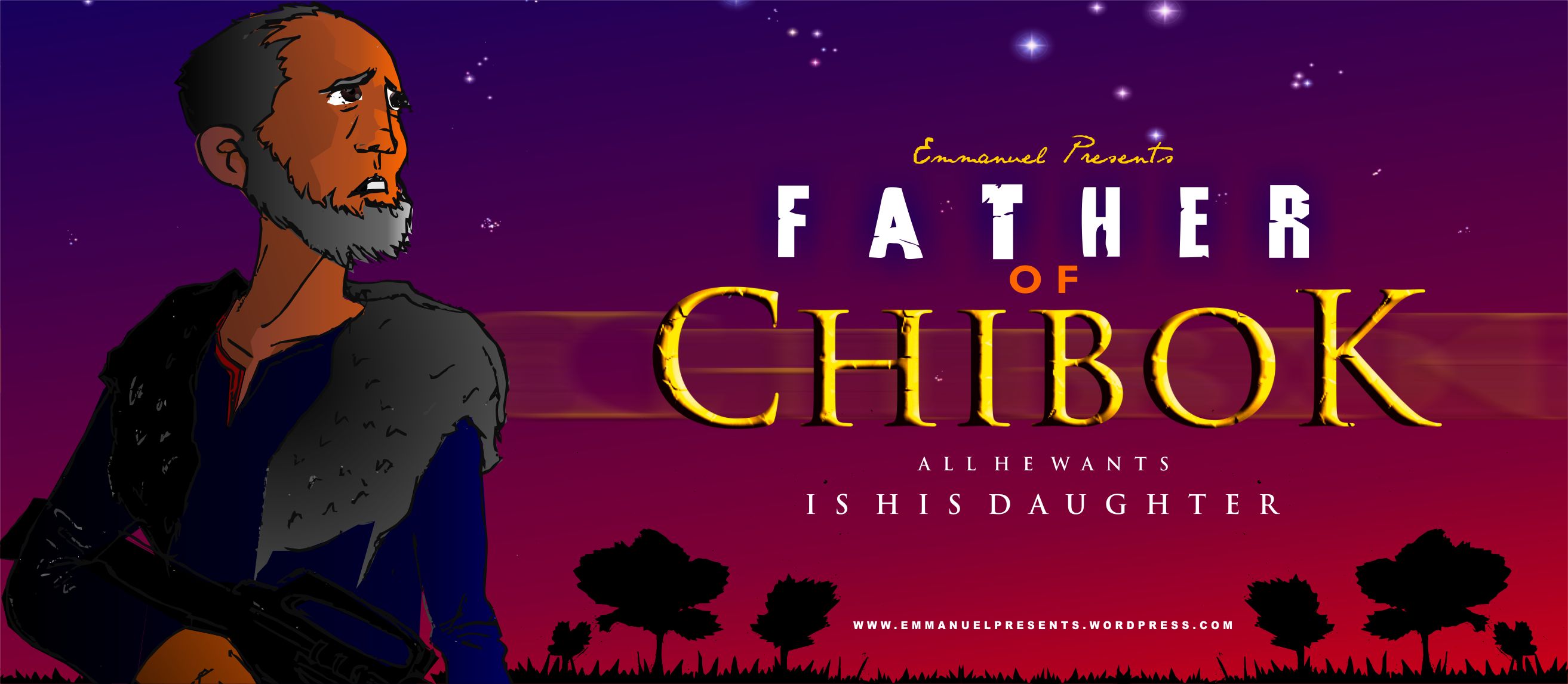
FATHER OF CHIBOK

Father of Chibok

…must … make it…

Can’t stop … can’t turn back…

I must…

… must …

… SIMBI …

With every step, Adamu ibn Gafar’s heart pummeled harder into his chest. His breath had turned to intermittent gasps. His strength was giving way. But he could not stop. Would not stop. His rifle weighed heavy on his neck by the strap.

A dry wind caressed his bearded face as he crested a knoll, leaving a gritty taste in his mouth. The valley before him, dotted with trees and sparse undergrowth, was laid out bare like an unfurled scroll of green and brown. The Sambisa forest. It would have been the perfect landscape were it not for the dark secrets hidden in there.

How many nights had it been now? Seven? Eight? Yes, eight nights since he’d left the village.

Three since he last ate.

Two since he last drank water. Dirty water, at that.

His head was already feeling dizzier with each new hour. He could feel every bone in his body. He knew he should have turned back a long time ago, but he had to keep his attention on something more important. His sole purpose for being here. His only purpose for living now.

Simbi … Simbi … must make it… It had become his mantra.

He did not even know where he was going. Everyone knew that the terrorists sometimes set up camp in this forest, but they were also constantly on the move. Only God knew exactly where they were. Gafar knew that he would most definitely die out here. His next step could plunge him to his grave…

Something about that thought must have been taken seriously, because the next thing he knew was that the horizon was rising unnaturally. The sandy ground was rising to his eye level … and growing darker. His scraggly beard bit into his skin as it touched down on sand.

Am I … falling?

BAM! His world faded to black.


———-

A crackle played at the back of his mind as he slowly regained consciousness. It could’ve been gunfire in the distance. A salty tang filled the air, assaulting his stomach. Oh, that churning curling feeling. How hungry he felt. Slowly, one of his eyes peeled. There was a fire, alright, but it wasn’t gunfire. More like a camp fire. It was in sharp contrast to the dark night around.

Wait a minute. Camp fire meant camp…

…and camp meant…

People!

He hurried to his haunches, scurrying away, but stopped at the sight before him. Only one man was seated in the sand facing the fire, his back to Gafar. He had seen no other human being in days. He noted that his rifle still sat beside him. Desperate not to make a sound, he slowly grabbed it from the grass at his knees.

Could it be? Had he finally reached their camp? Is he one of them?

Struggling to his feet, he sauntered slowly toward the stranger, reminded of the pain in his bones with every step he managed. The man was humming to himself, poking the fire with a stick. He was roasting some fish in the fire, hence the salty tang. Food! But Gafar would not kill a man for food … unless he was a no-good kidnapping insurgent—

But, still… FOOD!

“You’ve been out for hours.”

Gafar stopped. Who said that? He had been certain they were alone. Gafar had not seen another human in over a week. Had this man just spoken? Gafar knew he had been found out. He raised the rifle to the man’s head. He should have said something, but nothing came to mind.

The man turned slightly. “I thought you’d like some food.”

Gafar gulped, his throat dry more from hunger than from fear. “You have five seconds to tell me what you’re doing here.”

The man paused. “Clearly, I’m roasting fish—“

“Are you one of them?” Gafar snapped. “The Haram?”

The man turned and seemed to notice the rifle for the first time, his gaze falling to its barrel. But he didn’t flinch. “Why would I tell you that?”

“Answer me!”

The screeching of crickets in the distance gave an ambience to the scene. “What if I told you I was and you weren’t one of them? Or if I said I wasn’t, but you were one of them? Either way, one of us is dead already.” Gafar froze. The man smiled. “Consider me a friend, mallam.

“I have no friends on this path.”

“Then consider this an invitation. In a land such as this, we could all do with a companion.” The stranger patted the ground beside him. “Come. Eat.” A bowl of already roasted fish sat beside the man. “I also got some bread.” He extended his bag towards Gafar.

Gafar was torn. He should be pulling the trigger, but his hunger was too strong. He snatched the bag out of his hand and reached in for a loaf. Sure enough, he felt the soft loaves of bread in his hands. The aroma was too hard to resist. And he took a bite.

His gastric juices and salivary glands went to work. Goodness, he had not realized how hungry he really was until now. Whoever this stranger was, he had brought some good food. This was like a miracle … if you believed in such.

“You’re welcome,” the stranger muttered, returning to his roasting. “There’s a creek over there. The water’s cleaner than most.”

Gafar sat, taking more of the bread and fish. Out of habit he muttered his thanks. The man looked nothing like anyone else he had seen before in these parts. He knelt at the creek and gulped down a good helping of water. Sure enough it was clean water.

“God must be looking out for you,” the man said. “Few survive days in this forest on their own.”

Gafar did not respond. He preferred not to give much thought to God. He needed not to. For one thing, those perverted terrorists claimed to be fighting in His name. Why would God allow those men to take his daughter away? Either someone or something was wrong in that equation, or there really was no God. It just didn’t make sense. Without answers he chose to remain neutral on the subject.

“There’s a nomadic clan about a day away where we can trade that gun of yours for supplies,” he said. “But they’re always on the move.” Gafar arched a brow at the man, who shrugged. “I’ve lived in the Sambisa for a good while now. I know my way around here.”

Gafar studied the man as he returned to the fire. He wore a woolen jacket over his brown caftan. The white goatee framing his chin gave him a patriarchal look. Had he really lived here for long? He was in no mood for a conversation, but clearly this man was. “I thank you for the sustenance, sir. But one must wonder what would make a man like you to stay in this godforsaken forest.”

The man stared pointedly at him.“I could ask you the same question.”

“My path is no business of yours.”

“I see all kinds of men making their way through this forest every now and then,” he said. “Most with ill-intentions. You don’t strike me as their type.” He cocked his head, ostensibly studying Gafar. “But I can tell you that the enemies you seek will not be taken down with just one rifle.”

Gafar turned to him. So this man had deduced his vendetta. “You’ve … seen them?”

“Everyone knows when they camp, the Haram. Most families left the forest as soon as they started … ‘camping’ here.”

“Yet you remain.”

The man shrugged. “I’ve got greater concerns than my own safety,” he said. “As do you, I presume.”

“I’m grateful for the food, sir, but like I said, my path is of no concern to you.”

“One rifle cannot take down an entire camp of—“

“Sir, I would rather not talk about this.”

“Some would call that denial. “

“Sir, I really don’t like—“

“But you want to talk about it—“

Gafar shot to his feet. “Look! Your attempts to drive me out of my mind can’t go beyond how out of control I already am. I … ha … I … I don’t even know why I’m even trying to talk to you. I should have killed you and made off with your food when I had the chance.”

The man was smiling and it was annoying. “But you won’t, my friend.”

“Don’t be too sure.”

“You may be mad, but you’re not ax-crazy.”

“Yes! Yes! You got me there, old man! I am mad! I’m absolutely crazy! What was I thinking, coming in here with a borrowed gun? And you know something else, old man? I’m dead already. I’m a dead man! This is a dead man talking to you, right here! What have I got to lose?”

“A mad man and a dead man. That’s a very lethal combination…”

Gafar clenched his fists. “Tell that to those perverts.”

“…for you,” the man finished, his eyes glistening in the fire’s hue. “It’s lethal for you. And you know why? I can tell because I know who you are.”

“You don’t know the first thing about me.” The man just stared at him, with what looked like sympathy in his eyes. As far as Gafar was concerned, he was mocking his resolve.

“I know … that you’re a dangerous weapon to anyone that crosses your path now. And that’s because of who you are.” Gafar waited for the punch line. But when it did come it took the wind out of his sails. “You’re a father.”

Gafar froze, at a loss for words.

“They must have taken something most precious to you to bring you in here,” the man continued, his eyes on Gafar. “However insane this is. And I can think of nothing as precious as … as a child. A daughter.” He paused. “Your daughter.”

Gafar just stared at him. Exposed and vulnerable in that moment. Now, when he needed a smart comeback, nothing came. He just stood there and stared. “Well … well, it’s better than just sitting down and doing nothing.” He tried to avoid his gaze. “Like everyone else is doing.”

“How old was she?” the man’s voice was gentle.

Gafar stared into the fire. The thought that had been playing in the depths of his heart boiled to the surface. Simbi’s lost, and there’s nothing you can do about it.

For the first time in days, he let the teardrop trickle down his face. His resistance fell away. The heave in his chest was back. He could feel his pulse thumping in his forehead. He slowly sank to his seat.

The man just stared at him.

“Nineteen,” he whispered. “She was … only … nineteen.”

The crackle of the fire and the distant caw of hawks filled the silence that followed. His heart was breaking again. And, again, he was helpless.

“We hoped this would be the last WAEC that would get her into university. I didn’t think it was necessary. I only wanted her to get married and start a life as soon as possible. Her mother wanted our daughter to have a dream. A future. She made me promise —right there, as her life slipped away— to get our daughter through school. She would become a great woman. A princess that royalty would die for. But you know what? I never really realized how beautiful my daughter was already. A treasure…” he gulped. Now she was gone. Kidnapped. And who knew what else had become of her.

“What I would give for one more moment to hold her … to tell my daughter that I love her. I never told her that. I never … thought I needed to. I thought she always knew. But I would give anything! Even to the last of my cattle and my land, I would give it all. I just want my daughter to be safe…”

He was breaking down in front of a stranger, he realized. He had spent a week away from humans and he had already lost all his pride. “It’s been so long now. I saw that video, you know. They showed the girls, all in black. But I didn’t see my Simbi. They say they’ve been sold as slaves. Others say they’re dead. But I can’t believe that. I couldn’t live with myself if that happened.”

The man had just been listening, now there was nothing but sobbing and the crackle of the fire between them.

“You want to negotiate with them?” the man asked at last. “You mentioned giving your cattle.”

“What choice do I have?”

For a moment they simply stared into the fire. “You really do love your daughter,” the man said. Gafar wiped his eyes. “I know how you feel … friend.”

Don’t say that. You can’t possibly know how I feel.

He placed a hand on Gafar’s shoulder “You will see your daughter again. It’s the hope we fathers have to hold on to.” Gafar turned to him. “The enemy may take our daughters, but we’ll do everything to bring them back. Even to lay down our very lives. Because it’s everything we have to give.

“After all … that’s why I’m here as well,” the man said, turning back to the fire.

Gafar sniffed and turned to him. “They took your daughter too?”

The man stared into the fire for a moment. When he did reply his voice was nothing but a whisper. “Daughters.”

That stopped him. Gafar was shaken. Really?

This gave a whole new perspective to this man. His daughters had been taken as well, and he was here to rescue them. There were things he wanted to ask, but he couldn’t. It was just … surreal. And sad. Very sad. So he does know how I feel. “I’m … I’m sorry.”

How, if there is any justice in the universe, these things could go unpunished troubled Gafar. How could these people continue their evil crusade – and no one else wonders why?! God, are you even there?

“You asked me why I’m here, in this …as you called it, ‘godforsaken’ forest,” the man said, a slight quiver playing at the edge of his lips. “Now you know. I have to be close to my children, somehow. I’ve been here for ages, searching, ready to bring my daughters home.” He smiled, in spite of himself. “I couldn’t live with myself any other way, knowing they’re in the hands of such evil men. I couldn’t afford to.” He shook his head, staring into the distance, lost in thought. “This ‘fatherhood’ thing, it’s … it’s an occupational hazard.”

Gafar sighed deeply, looking up at the stars. “You know, sometimes I think that if I ever brought her back safe, I would take her out of this place. Out of this country. I’d sell everything I have to take us to somewhere safe. I would throw the biggest party ever for her and her friends. I would … I would let the whole world know that she’s the most beautiful girl of all. The most precious jewel to me. I would never yell at her again … ever…”

The man nodded silently. “The Father’s heart.”

For a moment they did not talk. Gafar absentmindedly took some more helpings of the bread with fish. These short silent moments that punctuated their conversation seemed, to Gafar, to bond them somehow. A sort of camaraderie between fathers desperate to bring their loved ones home. Through long and dark nights in the cold, the bites of parasites and the certainty of death, the thought of their daughters home and safe again could be the only thing keeping them going.

The man turned and stared into his eyes again. “You can be sure that I’ll let your daughter know how much you love her so.”

Gafar smiled, as the chilling realization that he would die overtook him. But he nodded. “I’d do the same if I saw yours.”

“Listen to me—“

“—But frankly I just might outlive you, old man—“

“No, wait, you’re not listening to me. I will let your daughter know you love her because I am with her.” Gafar squinted at him. “Right now.”

Gafar tried to make sense of the man’s sudden cryptic shift in gears. “What’re you saying?”

“You know full well what it is I am saying.”

“Who … who are you?”

That enigmatic smile was playing at his lips again. “Don’t you remember me? Adam?”

Gafar was taken aback. He didn’t recall telling this man his name, let alone his first name. “Are you … no … it can’t be…”

He nodded. “I am.”

And he smiled one more time.


———-

Incessant chirping played at the back of his mind as he slowly regained consciousness. It could’ve been the sound of angels greeting each other. Perhaps he was dead already. For real, this time. He felt full on the inside. Oh, the blessing of good food. Especially bread and fish … talk about a meal! Slowly, one of his eyes peeled open. There was chirping, alright, but there were no angels. More like birds—

Wait a minute!

As he hurried to his haunches, he was engulfed by the daylight around him. He was still in the forest, birds chirping in the trees. It was another day searching for his daughter. One thing that piqued his attention was that there was no evidence of a camp fire around him. No ashes. He turned and confirmed his last expectation – no creek either. Had it been a dream?

But if it had all been a dream, why did he feel as if he had eaten?

He inhaled deeply, staring up into the bright sky. It was a new day, with new dangers ahead. But never before had he felt so much resolve.

Miracles do happen, he mused.

Picking his rifle again, refreshed and filled on the inside he hurried on into a forest that, perhaps, wasn’t so godforsaken after all. To death. To life.

To his daughter.

For Simbi.

———-

“I’m absolutely convinced that nothing

nothing living or dead,

angelic or demonic,

today or tomorrow,

high or low,

thinkable or unthinkable—

ABSOLUTELY

NOTHING

can get between us and God’s love

because of the way that Jesus our Master has embraced us.”

Romans 8:38 and 39 (The Message)


———-

FATHER OF CHIBOK

Father of Chibok; Father of all.

I know You hear us when we call.

Thank You because You’re always near.

And, as You’re here, You’re also there.

You’re with our sisters and daughters in captivity.

Keep them, protect them … set them free.

I know You can

‘Cause You’re more than a man.

You loved them even before this all began.

Heal their hearts; heal their minds

Keep them from the fear that binds.

Our hearts go out to them too.

If anyone can bring them home, it’s You.

And Father,

This part is so hard that it barely even rhymes.

Help us … somehow … to pray for and love the men

Possessed by the spirit of terror.

For they terrorize and wish our nation ill

But unbeknownst to them, they are the captives, still.

Heal their hearts, heal their minds.

Free them from the bondage that binds.

Let them know that even in the darkest of forest

There’s a Father that loves them, and in seeking them, You don’t rest.

If anyone loves them, it’s definitely You.

Help us to love them like You do.

O Father of All; Father of Chibok

Thank You ‘cause You answer when we knock.

In the end, we know that Evil’s time is done.

In the End, evil is overcome.

Let Your Kingdom come and make this all right.

The world will be so much better with Your Light.

If anyone can do this, it’s going to be You.

What can we do?

Can You use us too?

Help us to lighten up this world

With your light as we do as we are called.

Reflecting your love to every fellow

That they may know that You love them so.

If You can use anyone, dear Jesus…

…thank You because it can be us.