
It has been my joy to follow the developments of NASA’s Artemis II mission around the Moon, and to see the enthusiasm it’s bringing to this generation. In these times however, I have also become more aware of a prevailing perspective that the Earth is flat and, to my surprise, just how widespread this view is. Many also hold to this conviction for religious reasons and this gives them a sense of legitimacy to their position. While I respect everyone’s right to an opinion, it’s a topic that fascinates me to no end.
As a Bible teacher and a Geographer (who would still like to be an Astronaut someday 😉), here’s my perspective on this (and I would love to read yours too!)
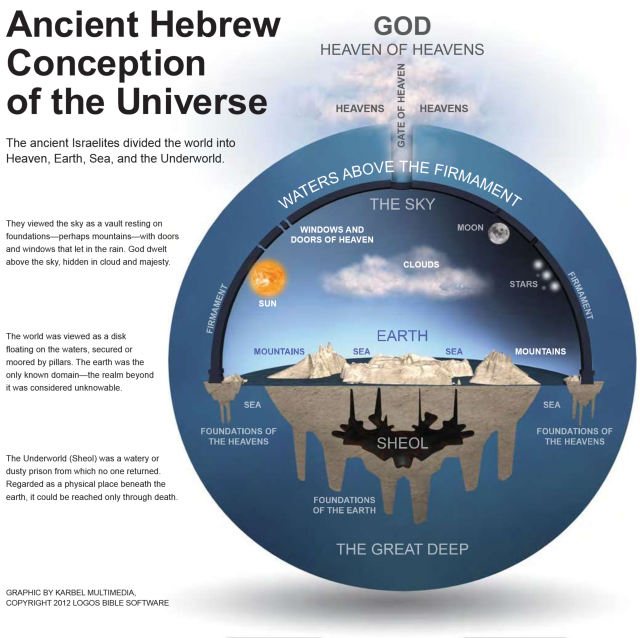
A cursory read of Bible texts seem to imply a Flat Earth geocentric universe (that’s a Universe with a flat earth at its centre). It seemed to imply that the Sun, Moon and Stars were part of this system, taking their course across our skies. It’s largely rooted in the cosmology of the primary readers of the times, from the perspective of the authors. Some of the passages in question are poetic in structure, such as in Psalm 19:6
[The Sun’s] rising is from the end of the heavens, and its circuit to the end of them, and there is nothing hidden from its heat.
In those days this was the prevailing view, even beyond Hebrew culture. Above this cosmos was where God, or the gods (depending on their theology) lived, while the dead would be relegated to nether regions of Sheol beneath. The core idea was that, over the cosmos, the One God is Creator and Lord over all, holding everything by His Power and in order.
But the world of science implies that the Earth is spherical, that it is one of the planets revolving around our Sun in a solar system, and that this is one of trillions of solar systems in the ‘known’ universe. I touched on this in the first episode of my show, CREATION’S WONDERS.
Proof of a Spherical Earth
To be fair to those who hold this view, the flat earth perspective isn’t entirely without intuitive appeal. From where we stand, the Earth does look and feel flat. The horizon appears level. We don’t feel ourselves hurtling through space at tens of thousands of kilometres per hour. And for much of human history, the greatest minds in the world shared this assumption. The flat earth community also raises questions about trusting institutions, photographic manipulation, and the reliability of government-backed science — concerns that, while I believe are misdirected here, come from a legitimate culture of questioning. It is worth engaging these honestly rather than dismissing them outright.
In light of these, here are a number of proofs I can highlight before we go forward as to why the Earth is spherical:
- Horizon Elevation: When ships sail away, they don’t just get smaller; the hull disappears first, followed by the mast. If the Earth were flat, the entire ship would remain visible. Also, as you climb higher up a tree or in a plane, your line of sight extends farther. The horizon appears farther away because you are seeing “around” the curve
- Lunar Eclipses: During a lunar eclipse, the Earth passes between the sun and moon, casting a curved shadow on the moon. This shadow is always round, which is only possible if the Earth is spherical
- Visibility of Stars: Different star constellations are visible from the Northern and Southern Hemispheres. For example, Polaris (the North Star) is not visible in the Southern Hemisphere, which would not happen on a flat plane.
- Circumnavigation: People have travelled around the world, such as Ferdinand Magellan’s expedition, returning to their starting point without ever encountering an edge
- Space Photography of Earth: Modern technology provides direct, high-quality images of Earth from satellites and astronauts in the International Space Station, showing a round, rotating planet.
- Modern Telecommunications and Travel: The functionality of satellite technology, global positioning systems (GPS), and radio propagation across long distances cannot be explained on a flat surface and requires calculations based on a spherical planet. Air travel and the installation of undersea cables are all based on calculations that take the curvature of the Earth into account. The very fact that you can read this online proves that these calculations are working.
The Bridge: Does this Negate My Faith?
So where’s the bridge? How does one encounter biblical perspectives while knowing these facts. It all comes down first to understanding WHY the Scriptures were written the way they were. I’ll start with an analogy.
In primary school we were taught that we breathe in oxygen and breathe out carbon dioxide. In later classes we learnt that both the air we breathe in and the air we breath out contain oxygen and carbon dioxide in different proportions (along with other gases). Our teachers did not lie to us. They simply emphasized what our minds needed and could grasp at the time.
Why the Bible Was Written That Way
The Scriptures weren’t written to explain everything about everything to everyone at every age. God inspired the writers — about 40 people across 1500 years — and their intellect with involved in writing such that the people of their time could understand what the texts were saying. The primary purpose of Scripture was to guide people to salvation; reconciling them to God through Christ. Like Paul the apostle wrote to his protegee, Timothy:
…from childhood you have known the Holy Scriptures, which are able to make you wise for salvation through faith which is in Christ Jesus. All Scripture is given by inspiration of God, and is profitable for doctrine, for reproof, for correction, for instruction in righteousness, that the man of God may be complete, thoroughly equipped for every good work. (2 Timothy 3:15-17)
That’s why its emphasis is God’s sovereignty in Creation, the Fall of Man in Sin, God’s workings with people in human history, Christ’s coming, His Death and Resurrection, the Church Age, Christ’s Return and the Coming Judgment, and the New Heaven and New Earth to come.
The Role of Science as Worship
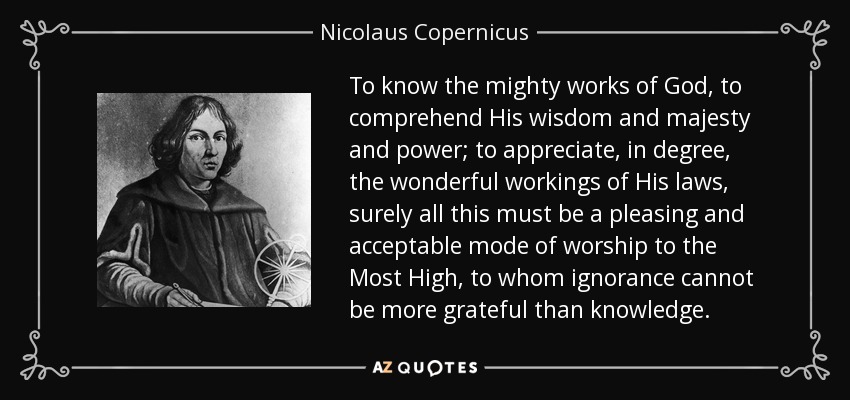
Science on the other hand, and all of knowledge by extension, is a tool our Creator blessed us with to explore, discover and better appreciate His wisdom and intentionality in Creation. Theologians have believed for centuries that God reveals Himself through the creative order (Psalm 19, Romans 1:20), and so have many scientists. As a matter of fact, the father of the heliocentric model, Nicolaus Copernicus considered the solar system a “world-machine established in our behalf by the best and most systematic Builder of all.” He said studying the order brings us to “wonder at the Artificer of all things, in Whom is all happiness and every good.” As profound as these thoughts were, his perspective saw what we know as the solar system as the whole universe. This shows us that knowledge is expanding.
I believe that Science is the unfolding reach of our understanding to discover and make sense of the Universe that God has made. Our understanding is expanding the more we know, and the more we know the more we can see of the intricacies of His work. It fuels our worship to understand that the grandness of the Universe tells us the capability of the One we call God, and Who invites us to call Him Father.
While we wrap our minds around these concepts, our Faith also lets us know that the physical laws of nature are not the ONLY rules guiding our existence.
Take the account in Joshua 10, where the Sun “stood still” over Gibeon. To the original readers, this was straightforward: the Sun moved across the sky, and God simply stopped it. Today, we understand that it is the Earth’s rotation that creates the appearance of the Sun’s movement. So what actually happened? If taken as a literal pause in Earth’s rotation, the physics are catastrophic. Inertia alone would produce winds of over 1,600 km/h, triggering tsunamis, volcanic eruptions, and the effective end of most life on Earth. None of that happened. So either the text is using phenomenological language (describing what was seen, not what mechanically occurred, much like we still say “sunrise” today) or God performed a miracle so precisely engineered that the physical consequences were suspended entirely. Both possibilities are consistent with a faith that believes in a God who is sovereign over the laws He authored. What the passage is really communicating is not a science lesson about celestial mechanics, but a theological statement: that God fights for His people, and that no battle is beyond His intervention.
The Author of this Story works within its plots and arcs towards His purpose.. This is what we call a Miracle. Miracles are part and parcel of this faith. The core of our belief is a Miracle, that God became a Man Who died, was buried, and resurrected to set us free. The Bible is full of miraculous invasions into the natural world, such as the Star of Bethlehem (which some debate whether it was a supernova, or a comet, or just that — a Star placed lightyears away before Christ was born) or the Red Sea parting, or rain falling after a drought. The difference for us is that we understand that Someone is working behind the scenes, giving purpose to it all.
The Two Books Perspective
Francis Bacon explained it this way, that God authored two distinct books: Scripture (theological truth) and Nature (scientific truth/Creation). These are complementary, not contradictory, and are both essential for our understanding.
Science and faith are not two fighters in opposing corners. They are two lenses through which we examine the same magnificent reality. The Book of Scripture tells us WHO made it all and WHY. The Book of Nature shows us HOW it was made and invites our endless wonder. A spherical, spinning Earth orbiting an average star in one of trillions of galaxies does not shrink God; it expands Him in our perspective. The deeper our knowledge reaches, the greater the One it points back to. You don’t have to choose between your Bible and your telescope. Pick up both.
 Emmanuel Onimisi